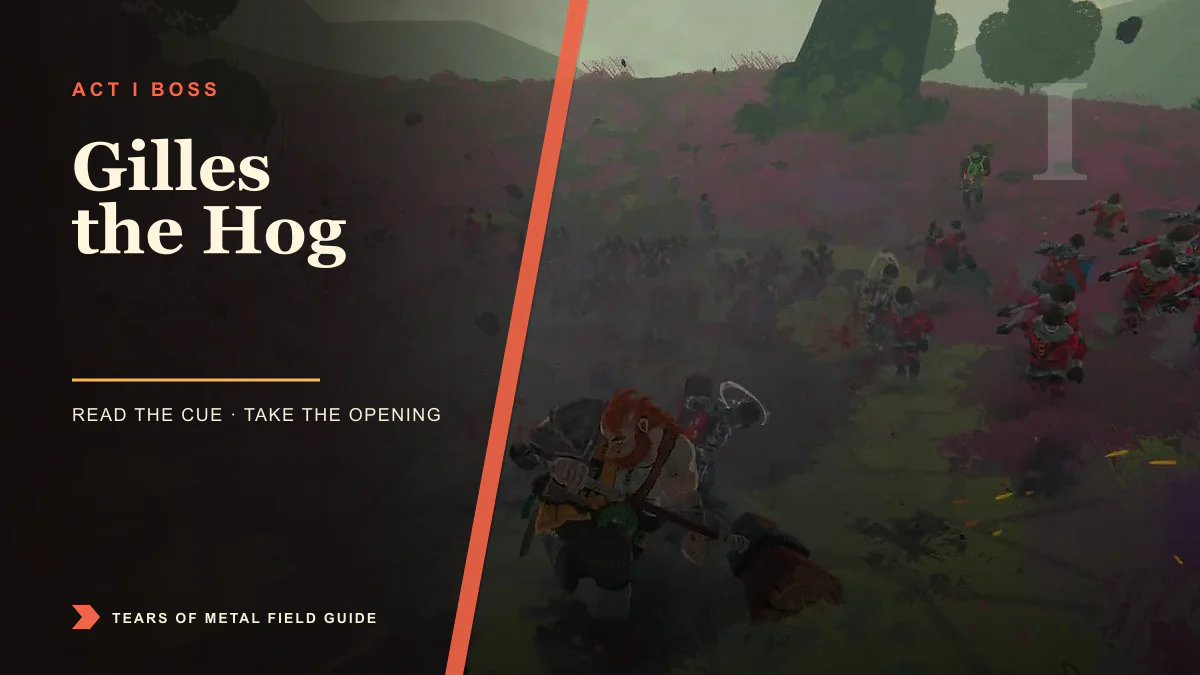
The safe Gilles strategy is to make him finish a sequence before attacking. Keep open ground behind you, move away from his running or multi-hit commitments, punish with one short combo, and reset. Gilles becomes dangerous when you stand beside him trying to complete a second finisher.
He is the Act 1 boss at the Great Gates. Defeating him awards the Butcher achievement and advances the campaign to Act 2.
Quick Gilles strategy
- Clear nearby soldiers only when they block your escape route.
- Keep Gilles near the center rather than fighting against the arena edge.
- Dodge his running attack and obvious ground-stab sequence instead of holding Block.
- Count the committed swings and wait for him to pause.
- Use one short combo or Ally Command during the recovery.
- Back out before he turns into the next sequence.
- When his pace increases, shorten the punish instead of trying to race his remaining health.
Recognize the dangerous attacks
| Visual cue | Safe response | Punish? |
|---|---|---|
| Gilles lowers his body and runs toward a target | Move sideways with room to finish the Dodge | Yes, after he passes and stops |
| Weapon rises for a heavy ground attack | Leave the impact area; do not rely on a held Block | Only after the full ground sequence |
| He begins alternating close swings | Move beyond the arc and wait for the chain to end | Yes, briefly |
| He turns while you are behind him | Leave immediately; rear attacks can catch greedy players | No |
| He pauses after repeated attacks | Close in for a short combo or command | Best opening |
Bait the running attack safely
Stand at medium range with enough empty floor on both sides. When Gilles commits to the run, move across his path late enough that he does not simply correct toward your new position. Continue moving until the attack has visibly ended.
Do not Dodge toward a wall or into a group of soldiers. The first movement can avoid Gilles while the arena edge or a second enemy traps the recovery. Returning him toward the center keeps the next cue visible.
Wait for the recovery window
Gilles spends stamina while attacking and eventually has to pause. You do not need to know an exact hidden value to use this: watch for a series of committed actions followed by a clear stop. That pause is safer than trying to interrupt the middle of a swing.
Use the opening for:
- a compact Strike string;
- a Heavy only if its startup and recovery fit;
- an Ally Command that can connect immediately;
- a status payoff already prepared by the build.
Leave before the next animation starts. If you cannot tell whether the pause is real, skip it and wait for the next one.
Second-half adjustment
Later in the fight, Gilles acts more aggressively and the arena can become harder to read. Preserve the same bait-and-punish loop, but remove one attack from your normal damage string. The lower his health becomes, the less reason there is to gamble the run on a long finisher.
High Threat can make the encounter less forgiving. If Gilles feels dramatically harder than the previous attempt, check how many optional nodes and failed objectives were added before the Great Gates.
Battalion and Emblem advice
Commands are most reliable after Gilles has passed the target or stopped attacking. Calling troops into the front of a running attack can waste both the command and the soldiers.
For Emblems, prefer a plan you can trigger from short contact:
- an effect attached to the defensive action you already use;
- a Strike or Heavy payoff that finishes quickly;
- passive survival or healing if one mistake currently ends the run;
- a crowd effect if reinforcements repeatedly close your escape lane.
See the Emblems guide if the reward screen is pulling the build in several unrelated directions.
Hero-specific notes
Wallace: use the defensive rhythm taught in the tutorial and keep attack strings compact. Gilles is a poor place to discover that a preferred Heavy takes longer than the opening.
Brienne: preserve movement space. Her pressure is useful only while the combo path does not carry her into Gilles’s next swing.
Ruadh normally unlocks after the Act 2 boss, so he is an option for repeat campaigns rather than a first Gilles clear.
Co-op strategy
Let the targeted player lead Gilles into open ground while the others attack from the side or rear only after a sequence ends. When Gilles changes targets, everyone should briefly reset; continuing a long animation as he turns is the most common co-op mistake.
Keep one player aware of downed allies and reinforcements. A revive beside Gilles is unsafe unless another player has already pulled his next approach away.
Common mistakes
- Holding Block against every large attack.
- Dodging early and letting the running attack correct into the landing.
- Using a long Heavy after only one swing.
- Fighting with the camera pressed against the arena boundary.
- Chasing every reinforcement while Gilles attacks off-screen.
- Treating low boss health as permission to trade hits.
Frequently asked questions
What Act is Gilles in?
Gilles the Hog is the Act 1 boss.
Can Gilles break Block?
Several of his committed attacks can break a held guard. Dodge or leave the attack area unless you are deliberately attempting a timed Parry.
What is the best time to attack Gilles?
Punish after his running attack ends or after he pauses at the end of a repeated attack sequence.
What do I get for beating Gilles?
The victory advances the campaign to Act 2 and awards the Butcher Steam achievement.
Return to the boss guide index or continue with the full campaign walkthrough.
Advertisement
Sources
- How to defeat Gilles the Hog — STAN Games & Tutorials Accessed 8/12/2026
- Paper Cult boss balance and patch updates Accessed 8/2/2026
- Current Early Access Gilles campaign footage Accessed 8/2/2026
- Gilles attack and stamina data from the launch build Accessed 8/2/2026
- Official Butcher achievement condition Accessed 8/2/2026
Last updated August 12, 2026