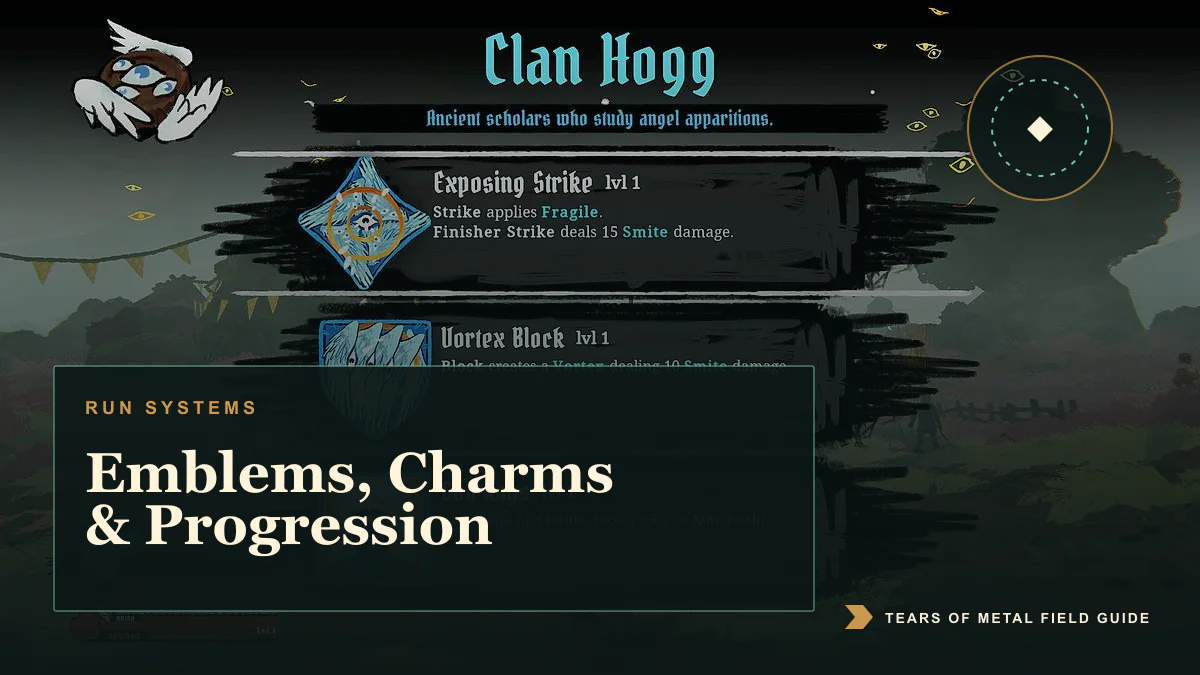
Tears of Metal has two connected progression layers. During a campaign, you build power through Emblems, Charms, Coins, and route rewards. In the village, you spend permanent resources on heroes, weapons, battalion preparation, and account-wide options that improve future starts.
The simplest rule is: if you picked it from a battle or bought it with Coins during the route, expect it to belong to that campaign; if you bought or unlocked it in the village, expect it to affect future campaigns.
Systems at a glance
| System | Main purpose | Where you manage it | After the campaign |
|---|---|---|---|
| Emblems | Modify actions and add family interactions | Battle rewards and campaign screens | Build is assembled again next run |
| Charms | Add passive or conditional benefits | Rewards, chests, merchants, and available unlock pools | Equipped campaign effects do not carry as a finished build |
| Weapons and hero skills | Define the hero’s base moves and permanent growth | Hero or Smithy-related village screens | Unlocked progression remains available |
| Battalion and commanders | Supply troops and Ally Commands | Barracks and War Preparations | Roster and village progression can shape later starts |
| Companions | Add a named support ally and bonus | Companion and preparation screens | Unlocked companion progression remains available |
| Village upgrades | Improve future campaigns or unlock options | Village buildings | Permanent |
| Coins | Pay for campaign healing, Chests, or merchants | Campaign map and encounters | Do not become village savings |
Emblems change actions and create interactions
Emblems are the main build-making layer inside a campaign. Active Emblems attach an effect to actions such as Strike, Heavy, Dodge, Block, or Ally Command. Passive Emblems strengthen a condition, payoff, defense, economy effect, or family mechanic.
A good Emblem build answers three questions:
- Which action applies the status or creates the setup?
- Which action converts it into damage, control, healing, or safety?
- Can the hero repeat that loop while completing objectives and defending?
The complete Emblems guide explains the current families and how to choose rewards without relying on a rigid tier list.
Charms are a separate passive layer
Charms do not replace active Emblem slots. They add passive, economic, defensive, or conditional effects and can appear through campaign rewards, chests, or merchant stock.
Choose a Charm that fixes the current run:
- survival when one mistake is fatal;
- damage for the action already carrying the build;
- economy only when enough route remains to repay it;
- crowd control or utility when objectives, not bosses, are the problem.
Do not buy a small unrelated bonus if the Coins are needed for healing before the boss.
The complete Charms guide explains rarity, duplicate stacks, acquisition routes, and how to check unlocked entries in Castle Records.
Equipment and special rewards
The current public build uses Emblems, Charms, weapons, equipment, and village upgrades as distinct progression layers. It does not provide a separate Artifact menu, reward pool, or equipment slot. Some guides use “Artifact” as a loose name for passive rewards; match those claims against the item label shown in your game.
Use the name shown on the current item panel. When comparing equipment or another reward, ask whether it works immediately, helps the hero or battalion, remains useful in the next Act, and competes with recovery spending.
Weapons and hero attacks
Weapons define the base action set that Emblems modify. Learn the unmodified Strike, Heavy, Dodge, Block, Special, and Ally Command rhythm before judging a build. An Emblem cannot make a long move safe if the boss opening is shorter than the animation.
Permanent weapon or hero improvements are handled from the relevant village screens. Concentrate on one weapon until its defensive timing and reliable finisher are familiar; then invest in alternatives for different heroes or achievement runs.
Battalion, commanders, and companions
Your army is not a single stat. Infantry, spearmen, and archers form the battalion; commanders connect named allies and commands to that army; companions are a separate support choice; the hero remains the character you control.
Use the Battalion Units guide for troop commands and army preparation, or the Companions guide for the two current unlock paths.
Before a campaign, confirm:
- the troop distribution;
- each commander and command slot;
- the active companion;
- whether a recent Barracks purchase added capacity;
- whether co-op preparation loaded the host’s available army slots correctly.
The village guide gives a problem-based upgrade order.
Coins and permanent currencies
Silver Coins are the campaign economy. Spend them on the current attempt: healing, Chests, merchant items, or other visible route costs. Keeping Coins only matters if a later purchase or an achievement requires it.
Other currencies shown in the village fund different permanent upgrade branches. The icon and required amount on the village panel are more useful than a single “best currency” rule. Save rare resources until a purchase changes a starting option you actually use.
How to decide between two rewards
Use this order:
- Stay alive: take the option that prevents the next likely failure.
- Complete an interaction: prefer a payoff for a status you already apply.
- Support the next encounter: boss damage and crowd clearing are different needs.
- Respect the hero’s timing: choose effects attached to actions you can land safely.
- Avoid dead economy: do not invest in future Coins when the campaign is about to end.
Higher rarity does not automatically make an effect better for the current build.
What resets after defeat or victory
The finished campaign build is not copied into the next run. Expect to choose Emblems and campaign items again and to start with a fresh Coin economy. Permanent hero, weapon, village, roster, and unlock progression remains available and changes the baseline of later attempts.
After a failed run, do not try to recreate every reward. Identify why it failed, make one permanent improvement if available, and choose a route that lets the next build answer that problem earlier.
Frequently asked questions
Are Emblems permanent?
The build assembled from Emblems belongs to the campaign. Unlocks can expand what may appear, but the equipped set is built again on later runs.
Are Charms the same as Emblems?
No. Charms form a separate passive item layer, while active Emblems can directly modify hero actions and family interactions.
Do Coins carry into the village?
No. Spend Coins for the current campaign or save them only for a specific route purchase or achievement.
Are village upgrades permanent?
Yes. Village and account progression improve future campaign starts.
What should I upgrade first?
Improve the system causing the current failure: hero baseline, battalion capacity, reward access, or survival. Avoid dividing rare resources evenly across options you do not use.
Advertisement
Sources
- Official Early Access systems and progression overview Accessed 8/2/2026
- Official Emblem and Charm development overview Accessed 8/2/2026
- Current Early Access campaign and reward footage Accessed 8/2/2026
- Player explanation of campaign and permanent progression Accessed 8/2/2026
Last updated August 2, 2026